Tuesday, November 11, 2014

Seeing is Believing, GSB Works!

If you visit Gee’s headquarters in Cedar Rapids, Ia, we'll invite you on the Asphalt Preservation Tour. Because, we haven’t just recently expanded into Asphalt Preservation methods and can only speculate about their performance. No, we have been conducting independent research since the 1970s! 

Not only have our research results remained consistent, but similar studies and findings conducted by expert entities including NAVFAC, FHWA, FAA, MDOT, and AZDOT have also proven the quantifiable benefits of Asphalt Preservation in sustaining the performance of asphalt pavements.

Case in point, Lakeside Drive:
* Installed in 2001
* 100 yard test pavement area
* Left lane treated with
   GSB every 5 years,
   while Right lane   
   remained untreated.


13 years later--the outcome is astounding!

Aggregates in the GSB lane remain tightly glued down while the lane itself appears to be from a much newer installation.

However, the untreated right lane is a real mess--severe cracking and raveling has allowed moisture and other elements to seep down and dry out the binder and completely weaken the pavement structure!

Both lanes are the same age, but it is clear the Right untreated lane, in Poor Condition, is nearing the end of it’s usefulness while the Left lane treated with GSB remains in Good Condition.


Here at Gee Asphalt, we have pavements that have been on a continuous asphalt preservation program for 40+ years and counting!

See for yourself how GSB can sustain pavement life! Give us a call for a free quote and start sustaining your pavements today!

Watch full video at :    https://www.youtube.com/watch?v=SecDJJNqt8E

Thursday, September 25, 2014

Why should you preserve a perfectly Good Runway?

Garfield County Regional Airport (RIL):
How a Pro-active Pavement Maintenance Strategy is saving this airport millions!

The Need for a Pro-active Strategy:
"In mountainous areas subject to extreme weather conditions, asphalt will fail after only 12 years, even if a runway was initially designed to structurally hold for 20 years."
–William VanHercke, Manager, Aviation Services, CH2M HILL's Northwest Mountain Region


“Research shows that if airports maintain asphalt pavement every three to five years, they can get more than 20 years out of a runway – if not 30.” –Joel Harry, Airfield Civil Engineer, Project Manager, CH2M HILL

"We (had) an absolutely perfect runway So, one month after it was finished, we completed a 20-year maintenance plan to make sure it stayed in that same condition."
–RIL Airport Director, Brian Condie

The Plan (Get Ahead of Deterioration Cycles):
Historically, RIL was forced to shut down each year for several days while the pavement surface was closely inspected and every crack sealed. This was a terrible inconvenience and loss of revenue for the airport and the whole community. Plus, Some RIL's runway pavement and joints were showing signs of premature raveling–only 3 short years after the runway was refurbished.
 
But, instead of waiting five years before taking steps to maintain their Good Condition runway, RIL developed a pro-active maintenance strategy to postpone a full resurfacing.

GSB Is the Solution:
RIL sought the advice of Asphalt Systems to determine the best long-term maintenance strategy while keeping the runway looking and performing like brand new. Together, it was decided GSB was the best solution.

GSB-88, made from a natural black bitumen, contains a rejuvenating agent that penetrates into the matrix providing long-term protection, while keeping the pavement pliable and flexible. And, because GSB is made from a long-chain hydrocarbon, it is extremely resistant to moisture and ultraviolet rays–preventing UV rays from breaking down vital oils.

GSB Is a Budget-saver!
Because the project came in around $300,000 (vs. the originally anticipated $470,000), RIL was able to carry over the airport's entitlement funds for use on a bigger project the following year.

But the money saving doesn’t stop there.
“By performing prompt preventative maintenance every few years, the airport expects to spend $1.5 million over 25 years vs. an estimated $6 million to resurface the runway twice."–William VanHercke, Manager, Aviation Services, CH2M HILL's Northwest Mountain Region

That’s over 3x in savings!!!


3 years after application, the GSB-treated surface remains in “like new” condition and performance! Now that’s a Win-Win result!

Plus, the New FAA P-608 Specification calls for Gilsonite Modified Asphalt Emulsion (GSB) to be used on all airfield pavements, including runways and high-speed taxiways! Start saving money and sustain the look and performance of your runway!
Contact us today!
--------------------------

Full quotes and related article:
Airport Improvement Magazine http://www.airportimprovement.com/content/story.php?article=00516

Thursday, August 14, 2014

New FAA P-608 Specification Calls for Emulsified Asphalt Seal Coat


Proven on 400+ airfields and 300+ runways nationwide, GSB-88® qualifies for AIP funds! 


The recently published Federal Aviation Administration’s revised Advisory Circular contains new and revised “P” Specs. One of the new additions is P-608 Emulsified Asphalt Seal Coat which calls
for Gilsonite Modified Asphalt Emulsion to be used on ALL airfield pavements, including runways and high-speed taxiways. Although P-608 is a new FAA specification, Gilsonite Modified Asphalt Emulsions have been used as highly effective airfield pavement preservation tools for 40+ years.

Gilsonite is Green Circle Certified and fully compatible with bitumen. As a resin, can be melted into hot bitumen, added during the hot-mix manufacturing  process, or blended into a preservation treatment as a uniform, easily workable product with minimal downtime.

Better than a typical sealer that sticks on top and wears away while allowing damage to weaken runway binders, GSB® penetrates through and becomes part of the surface creating a superior barrier against the elements, fuel spillage, and breakdown during daily use. Grooved runways need not be re-grooved, nor are PFC (porous friction course) asphalt surfaces altered.  

Gee Asphalt Systems, Inc.
    •    Family Owned and Operated.
    •    Recognized & Trusted Nationwide.
    •    Long-established Industry Leaders.
    •    Leaders in Advancing Preservation Strategies.
    •    Our skilled team of technicians and craftsmen have a combined experience of 150+ years.

As one of approximately 65 GSB® dealers in the United States, Gee Asphalt is the ONLY GSB® applicator with 41+ years of continuous experience traveling to projects nationwide. Let us show you how you can sustain your runways AND save money!


Thursday, July 24, 2014

Diverse Research Proves the Benefits of Preservation

As a family business, here at Gee, we have been conducting research on preservation products for close to 50 yrs and counting. But, as we all have observed firsthand, the asphalt industry has changed while costs have risen--and roads just don’t last as long as they used to. And, in response and under the mandate of reducing costs and sustaining vital infrastructure, many other entities (only some are listed above) have done independent research with all the same results:

The use of Preservation products can extend 2x the life of pavements and reduce overall maintenance costs.

But this research isn’t just filed away, it’s put into practice!

 While most of California’s highways are more than half a century old, they carry nearly half of the nation’s container freight. Recently the California Transportation Commission (Caltrans) initiated a “Fix It First” campaign, which includes preserving pavements that are in good condition from deteriorating. 

Caltrans Director Malcolm Dougherty reasons, “To get the most bang for the buck for taxpayers, Caltrans targets dollars where they are most effective--pavement preservation. Every $1 spent on preventive pavement maintenance saves Californians $11 that would have been spent on expensive pavement repairs.”
(Source: Central Valley Business Times / Sacramento, CA June 26th, 2014

)

Time and time again, test after test, pavements in Good Condition when treated with GSB, result in a  binder with unmatched strength–durability and bonding properties with high density–capable of preserving vital oils and flexibility in the pavement for decades of trouble free pavements and prolonged traffic load carrying capabilities! Contact us today and let us show you how we are preserving today’s infrastructure for future generations.

Monday, June 23, 2014

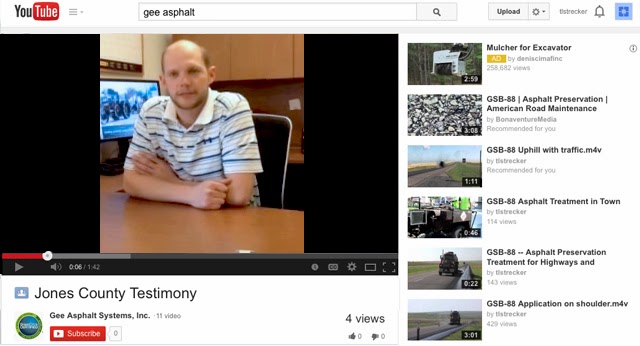
Interview with Derek Snead, P.E., Jones County Engineer


https://www.youtube.com/watch?v=X9U8rCEiJ4g 
We sat down with Derek to hear his professional take on the problems he and his peers face concerning aging asphalt pavements.

What are some of the current trends or changes you've seen in pavement management since you've been on duty here?

Derek – I think typically in the past there wasn't such an emphasis on shortage of funding so it was a practice of use the existing pavement 'til it's completely deteriorated (then) tear it up and put new back down. Recently the amount of existing pavement that is past its useful life is so broad and we have such a short fundage--short amount of funding--that tearing it up and repairing all the existing ones just isn't an option.

How are things different now (you touched on the limited budgets we have) and how have people dealt with roads in the past in maintenance and such? Has it been more reactive or proactive?

Derek – I would say it probably varies, but the majority of it has been reactive. When you do have a shorter budget you have some tough choices to make. A lot of times you try to use the existing pavement as long as you possibly can before replacement, and that's one way of looking at it, or the second way would be to utilize some of the existing strength of that pavement.

(Would you) say keeping a pavement flexible would be a benefit to helping survive some of the stress that's put on it?

Derek – Particularly if you have a flexible pavement like asphalt is, in order to make the life of it last longer, you want to keep it that way (flexible). It's not designed to be a rigid pavement. If it turns into one, then the lifespan of that (pavement) deteriorates.

We are a very rural community here. We have a lot grain carts, a lot of heavy equipment going back and forth on our roads. They (pavements) weren't necessarily designed for types of loads that are going over them currently. So heavy loads and weather are the two main factors in deterioration of our existing pavements.

So, we're trying as many ways to prolong the existing ones (pavements) as we possibly can. So to prolong the life of the existing pavement that we have so far, this GSB® was one solution we looked at to try to offset some of the replacement (cost) with extending the life of some of our paved roads here in the county. So far we are very happy with the product (GSB®).

Friday, May 16, 2014

GSB® Extends Pavement Life, and Our Customers are Saving REAL Money!

Proven by FHWA, FAA, NAVFAC, MDOT, and AZDOT research:
GSB® Asphalt Preservation Treatments can Save 10x over the Cost of 1 Asphalt Overlay!

The reality of the overwhelming costs of relying on a Worst-First Maintenance Strategy has left 60% of Jones County roads close to the end of their life-cycle. As in many counties, facing steep reconstruction costs and budget shortfalls, many engineers and decision-makers are looking for a better, more cost-effective strategy. See how GSB® was the strategy of choice for extending the roads of Jones County.

https://www.youtube.com/watch?v=anIah3jljYA

Derek Snead, P.E., Jones County Engineer.
"I’ve been working with the county for about 2 1/2 years now. We’re trying our best to keep up with the roads as best we can with the money we’ve got. Well, we have an extensive pavement system here in the county, about 150 miles of paved roads. Of those 150 miles, a chunk of them, over 60% are getting closes to the end of their life.

We obviously don’t have the funds to repair all the roads we want to. GSB® (Gilsonite Sealer Binder® Preservation Treatment) was one solution we looked at to try to offset some of the replacement (cost) with extending the life of some of our paved roads here in the county.

It (GSB®) was a very easy process. We did the project under traffic. It didn’t take very much time. (We found) GSB® penetrates deep into the existing pavement. That creates a flexible pavement which is what it was initially intended to be. It (GSB®) gets down deep into the pavement as opposed to just on the surface--it gets down into it and makes the whole thing flexible and kind of work together. Typically when we do sealants they’re more for cracks and the surrounding areas. This GSB® is more of a broader (application). It goes over the entire area. It protects from future cracks that aren’t maybe existing quite yet or are very small.

It (GSB®) seemed to to do the job it said it was going to do so far. So far, we are very happy with the product."

Friday, April 18, 2014

Our NEW Gee Overview Video!

Asphalt Preservation with Gee Asphalt Systems, Inc


Introducing a quick video all about Gee's proud history, mission, and the cost-saving benefits of using GSB to extend the life of your pavements.

Check our YouTube Channel to see examples of our processes and workmanship.