Showing posts with label worst-first. Show all posts

Sunday, March 22, 2015

Road Maintenance: We need to change our thinking–NOW.

Not just up to Congress to fix:
In the news, the ASCE graded our 4+ million miles of public roadways a “D” and ranked us 16th in the world! They concluded:


Plus, our economy is impacted as freight is slowed down, diverted, impeded on the way to ports, railways, and city centers—and the cost is passed down to the consumer.

This is making news alongside our almost bankrupt Federal Highway Trust Fund.
But, ear-marking more money and resources to reconstruct a lot of failing roads now just means the cycle will repeat itself in 20 years–and be even more expensive and dire.

This isn’t a problem that has crept up on us overnight.
The snowball has been forming as regular maintenance initiatives have been put on the back-burner. Especially repairing minor surface defects, that don’t seem to impact the average traveler and are expected even as roads age, are often perceived as unnecessary and even wasteful spending by states, counties, and municipalities.

We’ve been building roads the same way for 50 years:
The traditional way we think about the life of a road is adding to the problem. Even today, we build a road based on a 20 yr life-cycle, leave it alone for a number of years “because it looks and performs Good”, and then act when the damage is clearly visible with varying degrees of fixes; patches, crack-sealing, overlays—often determined by what’s available in the budget and not what’s best for the health of the road.

One significant problem:
By the time the damage IS seen, over time, the binder strength has already been compromised.

The “fix” does not work:
  • It does NOT improve binder health
  • It uses a lot of resources for little gain
In other-words, It does NOT significantly extend the life of the road.
Also, since the lion’s share of the road maintenance budget went towards trying to fix Poor Condition roads, little if any is left to maintain Good Condition roads.

A better way—We MUST Maintain Good Condition Roads:

Asphalt Preservation with GSB-88:
  • Penetrates into the pavement matrix; becomes part of the surface of asphalt, sealing and binding aggregates tightly together.
  • Halts surface oxidation/weathering
  • Lasts 2x as long as other products/extends pavement life
  • Saves 10x over the Cost of 1 Asphalt Overlay!
The Future Impact:

We need take responsibility NOW-road by road-at the local, county, state, and federal level, and do our part to ensure a sustainable infrastructure for our children.

If all Good Condition roads were maintained and preserved on a regular schedule not only would there be significant cost-savings, but road life would be extended 20-30, even 40+ yrs!

Sound too good to be true? We have pavements that have been in service for 42+ yrs! Let us show you how you can create sustainable roads. Contact us today!

Monday, June 23, 2014

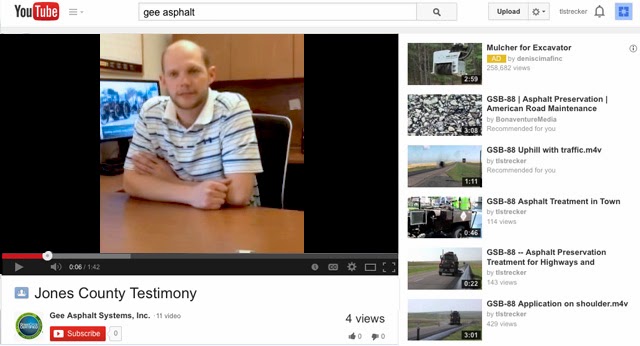
Interview with Derek Snead, P.E., Jones County Engineer


https://www.youtube.com/watch?v=X9U8rCEiJ4g 
We sat down with Derek to hear his professional take on the problems he and his peers face concerning aging asphalt pavements.

What are some of the current trends or changes you've seen in pavement management since you've been on duty here?

Derek – I think typically in the past there wasn't such an emphasis on shortage of funding so it was a practice of use the existing pavement 'til it's completely deteriorated (then) tear it up and put new back down. Recently the amount of existing pavement that is past its useful life is so broad and we have such a short fundage--short amount of funding--that tearing it up and repairing all the existing ones just isn't an option.

How are things different now (you touched on the limited budgets we have) and how have people dealt with roads in the past in maintenance and such? Has it been more reactive or proactive?

Derek – I would say it probably varies, but the majority of it has been reactive. When you do have a shorter budget you have some tough choices to make. A lot of times you try to use the existing pavement as long as you possibly can before replacement, and that's one way of looking at it, or the second way would be to utilize some of the existing strength of that pavement.

(Would you) say keeping a pavement flexible would be a benefit to helping survive some of the stress that's put on it?

Derek – Particularly if you have a flexible pavement like asphalt is, in order to make the life of it last longer, you want to keep it that way (flexible). It's not designed to be a rigid pavement. If it turns into one, then the lifespan of that (pavement) deteriorates.

We are a very rural community here. We have a lot grain carts, a lot of heavy equipment going back and forth on our roads. They (pavements) weren't necessarily designed for types of loads that are going over them currently. So heavy loads and weather are the two main factors in deterioration of our existing pavements.

So, we're trying as many ways to prolong the existing ones (pavements) as we possibly can. So to prolong the life of the existing pavement that we have so far, this GSB® was one solution we looked at to try to offset some of the replacement (cost) with extending the life of some of our paved roads here in the county. So far we are very happy with the product (GSB®).

Friday, May 16, 2014

GSB® Extends Pavement Life, and Our Customers are Saving REAL Money!

Proven by FHWA, FAA, NAVFAC, MDOT, and AZDOT research:
GSB® Asphalt Preservation Treatments can Save 10x over the Cost of 1 Asphalt Overlay!

The reality of the overwhelming costs of relying on a Worst-First Maintenance Strategy has left 60% of Jones County roads close to the end of their life-cycle. As in many counties, facing steep reconstruction costs and budget shortfalls, many engineers and decision-makers are looking for a better, more cost-effective strategy. See how GSB® was the strategy of choice for extending the roads of Jones County.

https://www.youtube.com/watch?v=anIah3jljYA

Derek Snead, P.E., Jones County Engineer.
"I’ve been working with the county for about 2 1/2 years now. We’re trying our best to keep up with the roads as best we can with the money we’ve got. Well, we have an extensive pavement system here in the county, about 150 miles of paved roads. Of those 150 miles, a chunk of them, over 60% are getting closes to the end of their life.

We obviously don’t have the funds to repair all the roads we want to. GSB® (Gilsonite Sealer Binder® Preservation Treatment) was one solution we looked at to try to offset some of the replacement (cost) with extending the life of some of our paved roads here in the county.

It (GSB®) was a very easy process. We did the project under traffic. It didn’t take very much time. (We found) GSB® penetrates deep into the existing pavement. That creates a flexible pavement which is what it was initially intended to be. It (GSB®) gets down deep into the pavement as opposed to just on the surface--it gets down into it and makes the whole thing flexible and kind of work together. Typically when we do sealants they’re more for cracks and the surrounding areas. This GSB® is more of a broader (application). It goes over the entire area. It protects from future cracks that aren’t maybe existing quite yet or are very small.

It (GSB®) seemed to to do the job it said it was going to do so far. So far, we are very happy with the product."

Friday, April 18, 2014

Our NEW Gee Overview Video!

Asphalt Preservation with Gee Asphalt Systems, Inc


Introducing a quick video all about Gee's proud history, mission, and the cost-saving benefits of using GSB to extend the life of your pavements.

Check our YouTube Channel to see examples of our processes and workmanship.

Monday, April 14, 2014

Are You Wasting Money on Crack Sealant?

“Nearly every surface defect started as a crack that got out of control. Each phase the remedy gets more expensive than the last. We’re here to break that cycle and to take care of your good pavements before it’s too late!” – Gee Asphalt Systems, Inc.

Did your crack sealant make it through the winter?

Last fall, many pavement owners spent good money fixing pavement cracks, but as the snow melted many failed fixes were revealed. 


But why did your crack sealant fail so quickly in the first place?

In most cases, the technique used to fill the cracks was substandard.


(Common) Blow & Go – (Not recommended):
Quick and cheap but least effective. Debris / dirt is blown and cracks filled leaving most of the sealant on top 
– vulnerable to being pulled out and scraped off – leaving your pavement further exposed to the elements, traffic and plows, and pedestrians during everyday use. And, once moisture follows down through the cracks and enters a pavement’s base and support structure, the rate of deterioration and damage and cost to repair will accelerate significantly unless you act quickly.


In addition, the sealant that does make it down into the crack has gritty, rough, unprepared surfaces which do not promote optimum bonding surfaces. Either way, sealant will need fixed a lot sooner than you think!

VS

Rout & Flush Pour
– (We recommend):
Quality sealant (Hot applied ASTM 3405 rubberized sealant; proven superior bonding properties, high resiliency – up to 300%, and great cold weather performance) is carefully placed into the routed, dried and prepared crack, filling up from the bottom, until flush with the surface. Voids and bubbles that can shorten the life of the crack seal are eliminated while also preventing most surface damage. This technique also yields and longest “like new” look and attractive appearance.

OR

Rout & Overband – (We recommend for failed repairs):

Effective for crack sealing previously sealed cracks that cannot be routed. Sealant is carefully placed into the dried and prepared crack, filling up from the bottom, and squeegeeing the sealant flush with the surface. This minimizes most damage from traffic, plows, and pedestrians but is less attractive than the Rout & Flush Pour technique.

For best, longer lasting results choose a trusted / knowledgeable expert installer!
It may look like a budget-saver, but as the old adage goes, “You get what you pay for.” You can risk hiring cheaper contractors but if they are not specifically trained in crack sealing, you will have to repeat the process again sooner, wasting your valuable time and money. Choosing a trusted/knowledgeable installer who will use quality products and the right equipment is key to to the long-term performance of any crack seal. We utilize state-of-the-art double jacketed melters designed to safely melt sealant, gently agitate, and then pump it through insulated hoses and specially designed applicators into cracks. We also equip our machines with self contained compressors to blow out oil free compressed air to better prepare cracks for sealant. When properly installed, hot applied crack sealants will last for years to come, protecting your pavement investment. Crack sealing is just one of several integral components in an overall preservation strategy.

Friday, March 7, 2014

The Pothole Epidemic


Freeze-thaw-moisture, freeze-thaw-moisture, freeze-thaw-moisture.
 

All across the nation, communities are dealing with an epidemic of potholes, possibly anticipated in aging streets, but also showing up in poorer quality repairs that just didn’t hold up under extreme winter conditions.

“Still, that (potholes) wouldn't be as big a problem had the nation invested more up front,” says Larry Galehouse, Engineer and Director of the National Center for Pavement Preservation.

"What people have to understand is you can't have a pothole without first having a crack in the pavement surface. Agencies have been cash-strapped for a number of years, and now it's all coming home to roost."

"If you've got a pavement in poor condition that's got a lot of alligator cracking ... where water is getting into the pavement and freezing and thawing, it's going to break up the structure," says Kevin J. Haas, Traffic Investigations Engineer, Oregon Department of Transportation, Salem. 


And to add weight to their statements, it’s no coincidence the American Society of Civil Engineers gave America's infrastructure (roads) a D last year.

And, now communities following Worst First Maintenance Strategies are just trying to keep up with the repairs and pay for it any way they can.

In New York City, 136,476 potholes have been patched since Jan. 1. — compared to the just under 57,000 by Jan 1 in 2013.

Closer to home, Cedar Rapids, Ia estimates the need to fix 100,000 potholes. So far the city has used over 120 tons of fill material. Paid for by local option sales tax, the city has purchased three new pothole mix spreaders for around $65,000 each and upgraded to a longer lasting premium mix—20% more expensive.


Still other communities are calling on volunteers to fill holes quickly with cold mix until permanent road patches can be made in April.

Better Quality vs Throw-and-Roll Methods:

“If a few simple and cost-effective measures are applied with each repair then there may be less need for as many repeat repairs and savings could be in the millions annually.”
— Mujib Rahman, co-author, Nottingham Trent University study, England.


The study found that applying a coat of bitumen emulsion between two layers of asphalt significantly improved its resistance to further cracks and confirmed a hot mix repair — in which the asphalt was heated to 284 degrees or higher — was the best option for fixing holes 1 inch and deeper.

Potholes Cause Property Damage:

TRIP, a nonprofit organization that researches surface transportation issues, estimated an average urban driver pays out $377 a year in repairs — or a total of $80 billion nationwide, with many flat tires caused by potholes. (based on 2013 data)

Keeping the Good Pavements Good:

Trying to put this all into perspective Larry Galehouse gives this statement, “Americans pay about $21 a month on average in state and federal road taxes — a fraction of what they pay for cable television or a cell phone. And yet what is one of our most (personal) expensive investments out there? It's our automobile. And we're wrecking our automobiles because we're hitting potholes ... The key is not fixing them. The key is preventing them."

Wouldn’t it make more sense to spend a dollar to preserve newer pavements, keeping them like new longer, rather than spending $10.80 to patch, repair and replace?

Sunday, February 9, 2014

New Branch Office Opens Near Chicago

Thanks to all our clients who are enjoying the benefits and overall cost-savings by preserving their asphalt pavements with us!

Now, just in time for the 2014 working season, we proudly announce the opening of our Chicagoland branch office in Somonauk, IL.

At our new branch office, you can expect the same great Gee quality, pride, and service you have come to expect from us...just now a little closer to you!

Sunday, January 5, 2014

Top New Years Resolutions for Pavement Maintenance

“GSB-88® Sealer Binder cost about 8x less than the cost of applying new asphalt.”
--Matt Hawks, General Manager, White Cloud Casino

“Thank-you for introducing us to a cost-effective and efficient product (GSB-88®)! All airfield users agree it is a great improvement rejuvenating a deteriorated taxiway into an almost new system.”

--Shaun Germolus, Director of Operations, Duluth International Airport

"Analysis shows GSB-88® yields a Savings-To-Investment Ratio (SIR) Of 5.0 and a Return On Investment (ROI) of 400%."

--GSB-88 NAVFAC Performance Report

“$1 spent today on pavement preservation reduces future replacement costs up to $10.80”

– Jim Sorensen, Director Pavement Preservation, FHWA
“Our parking lot was showing signs of deterioration. We needed to improve the appearance and safety. Replacement with new asphalt was going to be costly. We could replace it OR, preserve it by sealing the cracks and applying GSB®. We agreed to have Gee Asphalt Systems provide the pavement preservation services...and are very pleased.

--Matt Hawks, General Manager, White Cloud Casino


“GSB-88® is engineered to significantly retard surface oxidation by rebinding the surface aggregate and protect the pavement binder from the natural surface oxidation process. Surface oxidation is far and away the greatest deteriorating factor on the majority of DOD airfields.”

--DOD Comprehensive Evaluation of GSB-88® Sealer Binder

“Thank you for your assistance in providing a solution to our problem...The untreated test section showed extreme raveling with excessive loose aggregate and a very porous surface. The subsequent test application of GSB® has corrected this problem and has no doubt prolonged the life of this surface. It is evident the surface would have to have been replaced if not for the GSB® application.”
--Tom McCarthy, Operations Manager, Northpark Mall


“We are very satisfied with GSB® and over the years of wear and tear it has held up tremendously well. We have used other products over the years but they do not compare to the quality of the GSB® application.”

--Eugene Oakey, Director of Facilities, May Centers, Inc.


“Gee Asphalt showed me pavements where GSB® had been used from as little as 1 year ago, up to pavements maintained as long as 32 years, and they all looked amazing!”

--Brent Stansbury, Facility Engineer, Gateway, Inc.


“We wanted to try something besides the ss1h asphalt emulsions to keep aggregates bound in place on the shoulders, prevent raveling, and keep newly placed asphalt in a "like new" condition. We tried GSB-88®. Years later aggregates were still bound tightly in place...GSB-88® was applied to asphalt overlay projects having ADT (average daily traffic) ranging from 300-2600 vehicles. We will continue using GSB-88® for our asphalt preservation applications.”

--Allen Horak, District Maintenance Superintendent, Nebraska Department of Roads

 “I can’t say enough about Gee Asphalt, their professionalism, polite and courteous staff and customer satisfaction. They talk the talk and walk the walk! You continue to be a true pleasure to work with. Gee Asphalt has become an awesome partner in Asphalt Preservation!" 

--Scott Mallicoat, District Maintenance Supervisor, Farmington Schools

“Gee got the job done right!...Working with a company that gets the job done right the first time with little supervision is great! I look forward to working with Gee Asphalt in the future.”


--Les Lawson, Iowa State University, Facilities Planning & Management Campus Services

“From the salesperson to receptionist, owner to crew, these top-notch professionals exceeded our expectations with their fast and efficient, high quality work. Knowledgeable and courteous describes their staff and crew. I would highly recommend them.”


--Ms. Angie Ellison, Engineering Technician, City of Eagan Minnesota

“Everyone at Gee Asphalt Systems, from the owner to office staff to field crews, are professional and act with integrity.  They understand our shopping center clients and work diligently to minimize customer inconvenience."


--Thomas R. Zimmer, PE, Principal, Zimmer Consultants, Ltd

Make Gee part of your New Year's Resolution and improve the health of your pavements today!


Thursday, October 3, 2013

Is your runway maintenance strategy costing you money?

Here’s 2 scenarios with cost estimates. Which scenario can you relate to the most?


Scenario 1
8 yrs after runway installation, some raveling is noticeable and identified as a potential safety hazard. Budget for a a full mill down and overlay resurfacing project and make shut down preparations for at least a month. Afterwards, for a time, runway operates well. However, in 5-8 yrs raveling detected again. Again, budget for a resurfacing project and shut down for repairs.


Cost (2 resurfacing projects) = 6 million dollars.

+ Cost of runway shut down for 30+ days, 2x in a 25 yr life-cycle = ???


In 3-5 yrs more, notice structural integrity failure. Budget for complete tear out and reconstruction.


Scenario 2


In 5-8 yrs after runway installation (sooner for best results), seal with GSB-88 (Gilsonite Sealer Binder) before raveling is detected and close runway for 2 days. Runway is preserved in Good Condition. Plan to seal coat with GSB-88 every 5 yrs during a 25 yr life-cycle and keep runway in Good Condition for years longer than typical processes.

Cost (seal with GSB-88 every 5 yrs in a 25+ yr life-cycle) = $1.5 million

+ Cost of closing down runway for 2 days once every 5 yrs.


How can GSB-88 perform better than other processes?

Extensive research has validated: Unlike other processes that stick on the asphalt’s surface, GSB-88 will never crack, peel or delaminate. Because of it’s unique chemical properties, GSB-88 penetrates down into the matrix, becomes part of the surface, and forms a tight seal. In combination, the aging process is halted while pavement flexibility is preserved and load carrying ability is significantly extended.

The choice is yours!
Plan to spend some to preserve runway surfaces in Good Condition every 5 years OR spend 3x as much on resurfacing projects with lengthy closures!

Monday, August 12, 2013

Want to reduce maintenance costs up to 60%?

FHWA data states that $1 spent on Preservation reduces future replacement costs up to $10.80!

Known fact: A road is installed with a life-cycle. Often a decade passes and little is done to access its health. But soon, defects become unavoidable. Once the damage is visible, the binder remains unprotected and exposed. If left unchecked, it will continue to deteriorate at an alarming rate. At this stage, to stall further deterioration, temporary fixes often are applied--but they don’t improve the health and strength of the binder crucial to pavement longevity. Damage will continue to progress through the structure--and your road, now in Poor Condition will land at the top of your Reconstruction List.

There is a better way. Combat future reconstruction costs at the source--Plan to spend a little of your budget now and preserve Good Condition pavements in Good condition with GSB.


GSB is not your average coating. It is asphalt cement that not only penetrates down into the matrix but also moves at the same rate as asphalt pavement. Unlike surface coatings, GSB’s unique chemical makeup locks in vital oils and pavement flexibility. The result--pavements are preserved in Good Condition normally 2x as long as other processes!

GSB Works! We have pavements that have been on a strategic preservation program for 40+ years!


Call us today and let us show you how you can significantly reduce your maintenance costs with your own Strategic Preservation Program!

Saturday, July 13, 2013

What's Wrong with Worst-First Maintenance?

“We’ve always done it this way.”

It’s a familiar statement that approves the Worst-First maintenance strategy again for the next fiscal year. Yet the same decision-makers would agree the same statement is a business killer even among multi-million dollar companies revealing a lack in vision to meet consumer demands.


And the demands on our roadways are increasing. DOT and FHWA data state since 1960, roughly 3.69 million registered vehicles are added each year, with a 8 million jump in 2000-2001. In 2007, the passenger vehicle count was 254.4 million. Can the same road maintenance strategy used since the 1960’s or earlier really meet the current increasing demand?

U.S. roads are estimated as an 80 trillion dollar asset or 7 billion per day. As the number of vehicles on U.S. roads increase, the need for more roads kept in Good Condition increases, while reconstruction costs are also on the rise. So the way “we’ve always done it” Worst-First strategy–fix it, fix it, fix it, then reconstruct–does not protect your asset and is wasting more of your budget than you think. 


Take a Pro-active approach to pavement maintenance! Get ahead of the breakdown cycle and bypass the expensive temporary fixes and reconstruction costs. Our Solution: Preserve Good Condition pavements with Gilsonite Sealer Binder (GSB). GSB Sealer Binder out performs every other asphalt emulsion (polymer modified too) in wet track abrasion tests, increased permeability, reduced viscosity, and reduction of oxidation processes--and keeps asphalt pavement performing like new for many years–normally 2x as long as other processes. Gee Asphalt has pavements that have been on a continuous preservation program for 39 years and counting!

GSB, as part of a proactive preservation program, has been proven to reduce pavement maintenance costs by up to 60%!

Gee Asphalt offers the following services in Preservation/Preventative Maintenance:


Gilsonite Sealer Binder (GSB)
Crack Sealing
Slurry Mac


Let us show you how your maintenance strategy can become more effective save you money!

Monday, June 3, 2013

Quality Crack Sealing

Once pavement has hardened allowing moisture to enter the base and support structure of your pavement, the rate of deterioration and damage and cost to repair will accelerate significantly unless you act quickly.


Choosing quality sealant materials and installing them correctly is critical to the long-term performance of any crack seal and is best handled by experts with knowledge, skill and the right equipment to do the job right. You can risk hiring cheaper contractors but if they are not specifically trained in crack sealing, you will have to repeat the process again sooner, wasting your valuable time and money.


Here at Gee, our expertly trained technicians only install products we are 100% confident in and meet our high standards; crack sealant must bond well to crack walls, be elastic enough to stretch without tearing apart in cold temperatures, and not track when temps go up to 100 degrees or more. Crafco, W.R. Meadows, and Maxwell hot applied crack sealants meet ASTM 3405 standards and our high performance expectations.

Proper Technique is Key! Successful crack sealing requires that all cracks are properly prepared; cleaned (using oil-free compressed air) and completely dry. Only then is sealant poured into the crack, filling from the bottom up until sealant is flush with the surface – to prevent voids or bubbles that can shorten the life-cycle of the crack sealing process while also preventing most damage from traffic, plows and pedestrians.

 Hot applied sealants are recommended for the majority of our clients because they prove most cost-effective and last years longer. Hot pour sealants are melted down on your job site in a specialized double jacketed melter applicator. We also install single and double component cold applied crack sealants during fringe season or southern climates.

Don’t risk further damage to your investment!
Using skilled technicians and proper techniques is key to every successful crack sealing project. Call us today for a free consultation and cost estimate!

Monday, May 6, 2013

Change the Way You Think About Pavement Maintenance!

There is a vicious spending cycle that is eating away at our county and city budgets. The “Worst First” maintenance strategy allocates budget dollars for rehabilitation of the very worst pavements, leaving little or no money left to spend on maintaining Good condition pavements. 


Change the Way You Think About Pavement Maintenance!
While preventing oxidation of the asphalt binder is a "first priority" and is critical to pavement longevity, once the binder is exposed, if neglected, Good condition pavements quickly deteriorate and will end up at the top your reconstruction list sooner than you think!

There is a better strategy! Bypass the expensive cycle of temporary fixes and reconstruction costs by preserving Good condition pavements with Gilsonite Sealer Binder (GSB). GSB Sealer Binder out performs every other asphalt emulsion (polymer modified too) in wet track abrasion tests, increased permeability, reduced viscosity, and reduction of oxidation processes--and keeps asphalt pavement performing like new for many years–normally twice as long as other processes.

GSB, as part of a proactive preservation program, has been proven to reduce pavement maintenance costs by up to 60%!

Changing the way you think about maintaining your network of pavements requires planning, perseverance and getting the whole organization up to speed on the benefits of preservation, all the way from the field and operations people, up to the top management and ownership. This can be a challenge, especially when the system has always been run "this way." But, if the experts are in agreement about the benefits and budget-savings, isn’t it about time to reevaluate how your organization thinks about preservation and your pavement maintenance strategy?

Friday, March 1, 2013

Considering Coal Tar Sealant? You may be doing more harm than you think!


Like many of your peers, you may be seeing your pavement maintenance budget shrink. While Coal Tar might look budget friendly, increasing studies lay solid scientific proof to decades of speculation that the chemicals in Coal Tar Sealants are toxic and even deadly to the surrounding environment.

Linked to tumors and death in fish and cancers in humans, ongoing research now shows that extremely high levels of PAHs (toxins) are released in the air as the Sealant is applied and curing.

Further studies of the effects of abraded particles as Coal Tar Sealants age, also have produced alarming results outside and in homes, buildings, and water sources. Coal Tar pitch is cited as a Hazardous Substance by OSHA, ACGIH,DOT, NIOSH, NTP, IARC, and NFPA.

While it is true PAHs are produced by a variety of products and processes – Coal Tar products contain 1,000 times more harmful PAHs than asphalt based sealcoat products.

In response, many municipalities have banned the use of Coal Tar products and/or created expensive remediation laws/programs to safely remove and dispose of Coal Tar’s toxic substances.

Also, Coal Tar Sealants only last 2-4 yrs (and wear off, depositing toxic Sealant material elsewhere!), AND high traffic areas show wear and tear after a few months after application, Coal Tar Sealants aren't that effective in the long-term care of your pavements.

What more info? Go to link here.  http://www.geeasphalt.com/#!coal-tar-hazards/caq3