Monday, June 23, 2014

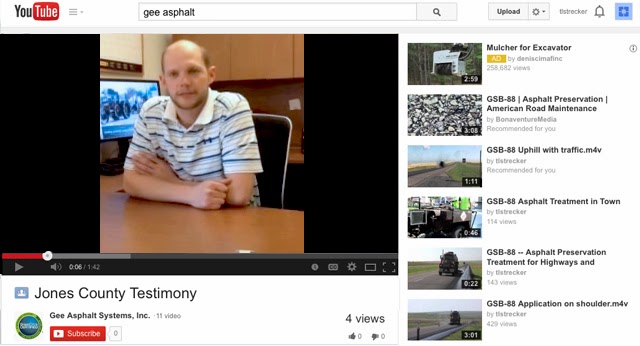
Interview with Derek Snead, P.E., Jones County Engineer


https://www.youtube.com/watch?v=X9U8rCEiJ4g 
We sat down with Derek to hear his professional take on the problems he and his peers face concerning aging asphalt pavements.

What are some of the current trends or changes you've seen in pavement management since you've been on duty here?

Derek – I think typically in the past there wasn't such an emphasis on shortage of funding so it was a practice of use the existing pavement 'til it's completely deteriorated (then) tear it up and put new back down. Recently the amount of existing pavement that is past its useful life is so broad and we have such a short fundage--short amount of funding--that tearing it up and repairing all the existing ones just isn't an option.

How are things different now (you touched on the limited budgets we have) and how have people dealt with roads in the past in maintenance and such? Has it been more reactive or proactive?

Derek – I would say it probably varies, but the majority of it has been reactive. When you do have a shorter budget you have some tough choices to make. A lot of times you try to use the existing pavement as long as you possibly can before replacement, and that's one way of looking at it, or the second way would be to utilize some of the existing strength of that pavement.

(Would you) say keeping a pavement flexible would be a benefit to helping survive some of the stress that's put on it?

Derek – Particularly if you have a flexible pavement like asphalt is, in order to make the life of it last longer, you want to keep it that way (flexible). It's not designed to be a rigid pavement. If it turns into one, then the lifespan of that (pavement) deteriorates.

We are a very rural community here. We have a lot grain carts, a lot of heavy equipment going back and forth on our roads. They (pavements) weren't necessarily designed for types of loads that are going over them currently. So heavy loads and weather are the two main factors in deterioration of our existing pavements.

So, we're trying as many ways to prolong the existing ones (pavements) as we possibly can. So to prolong the life of the existing pavement that we have so far, this GSB® was one solution we looked at to try to offset some of the replacement (cost) with extending the life of some of our paved roads here in the county. So far we are very happy with the product (GSB®).

Friday, May 16, 2014

GSB® Extends Pavement Life, and Our Customers are Saving REAL Money!

Proven by FHWA, FAA, NAVFAC, MDOT, and AZDOT research:
GSB® Asphalt Preservation Treatments can Save 10x over the Cost of 1 Asphalt Overlay!

The reality of the overwhelming costs of relying on a Worst-First Maintenance Strategy has left 60% of Jones County roads close to the end of their life-cycle. As in many counties, facing steep reconstruction costs and budget shortfalls, many engineers and decision-makers are looking for a better, more cost-effective strategy. See how GSB® was the strategy of choice for extending the roads of Jones County.

https://www.youtube.com/watch?v=anIah3jljYA

Derek Snead, P.E., Jones County Engineer.
"I’ve been working with the county for about 2 1/2 years now. We’re trying our best to keep up with the roads as best we can with the money we’ve got. Well, we have an extensive pavement system here in the county, about 150 miles of paved roads. Of those 150 miles, a chunk of them, over 60% are getting closes to the end of their life.

We obviously don’t have the funds to repair all the roads we want to. GSB® (Gilsonite Sealer Binder® Preservation Treatment) was one solution we looked at to try to offset some of the replacement (cost) with extending the life of some of our paved roads here in the county.

It (GSB®) was a very easy process. We did the project under traffic. It didn’t take very much time. (We found) GSB® penetrates deep into the existing pavement. That creates a flexible pavement which is what it was initially intended to be. It (GSB®) gets down deep into the pavement as opposed to just on the surface--it gets down into it and makes the whole thing flexible and kind of work together. Typically when we do sealants they’re more for cracks and the surrounding areas. This GSB® is more of a broader (application). It goes over the entire area. It protects from future cracks that aren’t maybe existing quite yet or are very small.

It (GSB®) seemed to to do the job it said it was going to do so far. So far, we are very happy with the product."

Friday, April 18, 2014

Our NEW Gee Overview Video!

Asphalt Preservation with Gee Asphalt Systems, Inc


Introducing a quick video all about Gee's proud history, mission, and the cost-saving benefits of using GSB to extend the life of your pavements.

Check our YouTube Channel to see examples of our processes and workmanship.

Monday, April 14, 2014

Are You Wasting Money on Crack Sealant?

“Nearly every surface defect started as a crack that got out of control. Each phase the remedy gets more expensive than the last. We’re here to break that cycle and to take care of your good pavements before it’s too late!” – Gee Asphalt Systems, Inc.

Did your crack sealant make it through the winter?

Last fall, many pavement owners spent good money fixing pavement cracks, but as the snow melted many failed fixes were revealed. 


But why did your crack sealant fail so quickly in the first place?

In most cases, the technique used to fill the cracks was substandard.


(Common) Blow & Go – (Not recommended):
Quick and cheap but least effective. Debris / dirt is blown and cracks filled leaving most of the sealant on top 
– vulnerable to being pulled out and scraped off – leaving your pavement further exposed to the elements, traffic and plows, and pedestrians during everyday use. And, once moisture follows down through the cracks and enters a pavement’s base and support structure, the rate of deterioration and damage and cost to repair will accelerate significantly unless you act quickly.


In addition, the sealant that does make it down into the crack has gritty, rough, unprepared surfaces which do not promote optimum bonding surfaces. Either way, sealant will need fixed a lot sooner than you think!

VS

Rout & Flush Pour
– (We recommend):
Quality sealant (Hot applied ASTM 3405 rubberized sealant; proven superior bonding properties, high resiliency – up to 300%, and great cold weather performance) is carefully placed into the routed, dried and prepared crack, filling up from the bottom, until flush with the surface. Voids and bubbles that can shorten the life of the crack seal are eliminated while also preventing most surface damage. This technique also yields and longest “like new” look and attractive appearance.

OR

Rout & Overband – (We recommend for failed repairs):

Effective for crack sealing previously sealed cracks that cannot be routed. Sealant is carefully placed into the dried and prepared crack, filling up from the bottom, and squeegeeing the sealant flush with the surface. This minimizes most damage from traffic, plows, and pedestrians but is less attractive than the Rout & Flush Pour technique.

For best, longer lasting results choose a trusted / knowledgeable expert installer!
It may look like a budget-saver, but as the old adage goes, “You get what you pay for.” You can risk hiring cheaper contractors but if they are not specifically trained in crack sealing, you will have to repeat the process again sooner, wasting your valuable time and money. Choosing a trusted/knowledgeable installer who will use quality products and the right equipment is key to to the long-term performance of any crack seal. We utilize state-of-the-art double jacketed melters designed to safely melt sealant, gently agitate, and then pump it through insulated hoses and specially designed applicators into cracks. We also equip our machines with self contained compressors to blow out oil free compressed air to better prepare cracks for sealant. When properly installed, hot applied crack sealants will last for years to come, protecting your pavement investment. Crack sealing is just one of several integral components in an overall preservation strategy.

Friday, March 7, 2014

The Pothole Epidemic


Freeze-thaw-moisture, freeze-thaw-moisture, freeze-thaw-moisture.
 

All across the nation, communities are dealing with an epidemic of potholes, possibly anticipated in aging streets, but also showing up in poorer quality repairs that just didn’t hold up under extreme winter conditions.

“Still, that (potholes) wouldn't be as big a problem had the nation invested more up front,” says Larry Galehouse, Engineer and Director of the National Center for Pavement Preservation.

"What people have to understand is you can't have a pothole without first having a crack in the pavement surface. Agencies have been cash-strapped for a number of years, and now it's all coming home to roost."

"If you've got a pavement in poor condition that's got a lot of alligator cracking ... where water is getting into the pavement and freezing and thawing, it's going to break up the structure," says Kevin J. Haas, Traffic Investigations Engineer, Oregon Department of Transportation, Salem. 


And to add weight to their statements, it’s no coincidence the American Society of Civil Engineers gave America's infrastructure (roads) a D last year.

And, now communities following Worst First Maintenance Strategies are just trying to keep up with the repairs and pay for it any way they can.

In New York City, 136,476 potholes have been patched since Jan. 1. — compared to the just under 57,000 by Jan 1 in 2013.

Closer to home, Cedar Rapids, Ia estimates the need to fix 100,000 potholes. So far the city has used over 120 tons of fill material. Paid for by local option sales tax, the city has purchased three new pothole mix spreaders for around $65,000 each and upgraded to a longer lasting premium mix—20% more expensive.


Still other communities are calling on volunteers to fill holes quickly with cold mix until permanent road patches can be made in April.

Better Quality vs Throw-and-Roll Methods:

“If a few simple and cost-effective measures are applied with each repair then there may be less need for as many repeat repairs and savings could be in the millions annually.”
— Mujib Rahman, co-author, Nottingham Trent University study, England.


The study found that applying a coat of bitumen emulsion between two layers of asphalt significantly improved its resistance to further cracks and confirmed a hot mix repair — in which the asphalt was heated to 284 degrees or higher — was the best option for fixing holes 1 inch and deeper.

Potholes Cause Property Damage:

TRIP, a nonprofit organization that researches surface transportation issues, estimated an average urban driver pays out $377 a year in repairs — or a total of $80 billion nationwide, with many flat tires caused by potholes. (based on 2013 data)

Keeping the Good Pavements Good:

Trying to put this all into perspective Larry Galehouse gives this statement, “Americans pay about $21 a month on average in state and federal road taxes — a fraction of what they pay for cable television or a cell phone. And yet what is one of our most (personal) expensive investments out there? It's our automobile. And we're wrecking our automobiles because we're hitting potholes ... The key is not fixing them. The key is preventing them."

Wouldn’t it make more sense to spend a dollar to preserve newer pavements, keeping them like new longer, rather than spending $10.80 to patch, repair and replace?

Sunday, February 9, 2014

New Branch Office Opens Near Chicago

Thanks to all our clients who are enjoying the benefits and overall cost-savings by preserving their asphalt pavements with us!

Now, just in time for the 2014 working season, we proudly announce the opening of our Chicagoland branch office in Somonauk, IL.

At our new branch office, you can expect the same great Gee quality, pride, and service you have come to expect from us...just now a little closer to you!

Sunday, January 5, 2014

Top New Years Resolutions for Pavement Maintenance

“GSB-88® Sealer Binder cost about 8x less than the cost of applying new asphalt.”
--Matt Hawks, General Manager, White Cloud Casino

“Thank-you for introducing us to a cost-effective and efficient product (GSB-88®)! All airfield users agree it is a great improvement rejuvenating a deteriorated taxiway into an almost new system.”

--Shaun Germolus, Director of Operations, Duluth International Airport

"Analysis shows GSB-88® yields a Savings-To-Investment Ratio (SIR) Of 5.0 and a Return On Investment (ROI) of 400%."

--GSB-88 NAVFAC Performance Report

“$1 spent today on pavement preservation reduces future replacement costs up to $10.80”

– Jim Sorensen, Director Pavement Preservation, FHWA
“Our parking lot was showing signs of deterioration. We needed to improve the appearance and safety. Replacement with new asphalt was going to be costly. We could replace it OR, preserve it by sealing the cracks and applying GSB®. We agreed to have Gee Asphalt Systems provide the pavement preservation services...and are very pleased.

--Matt Hawks, General Manager, White Cloud Casino


“GSB-88® is engineered to significantly retard surface oxidation by rebinding the surface aggregate and protect the pavement binder from the natural surface oxidation process. Surface oxidation is far and away the greatest deteriorating factor on the majority of DOD airfields.”

--DOD Comprehensive Evaluation of GSB-88® Sealer Binder

Thank you for your assistance in providing a solution to our problem...The untreated test section showed extreme raveling with excessive loose aggregate and a very porous surface. The subsequent test application of GSB® has corrected this problem and has no doubt prolonged the life of this surface. It is evident the surface would have to have been replaced if not for the GSB® application.”
--Tom McCarthy, Operations Manager, Northpark Mall


“We are very satisfied with GSB® and over the years of wear and tear it has held up tremendously well. We have used other products over the years but they do not compare to the quality of the GSB® application.”

--Eugene Oakey, Director of Facilities, May Centers, Inc.


“Gee Asphalt showed me pavements where GSB® had been used from as little as 1 year ago, up to pavements maintained as long as 32 years, and they all looked amazing!”

--Brent Stansbury, Facility Engineer, Gateway, Inc.


“We wanted to try something besides the ss1h asphalt emulsions to keep aggregates bound in place on the shoulders, prevent raveling, and keep newly placed asphalt in a "like new" condition. We tried GSB-88®. Years later aggregates were still bound tightly in place...GSB-88® was applied to asphalt overlay projects having ADT (average daily traffic) ranging from 300-2600 vehicles. We will continue using GSB-88® for our asphalt preservation applications.”

--Allen Horak, District Maintenance Superintendent, Nebraska Department of Roads

 “I can’t say enough about Gee Asphalt, their professionalism, polite and courteous staff and customer satisfaction. They talk the talk and walk the walk! You continue to be a true pleasure to work with. Gee Asphalt has become an awesome partner in Asphalt Preservation!" 

--Scott Mallicoat, District Maintenance Supervisor, Farmington Schools

Gee got the job done right!...Working with a company that gets the job done right the first time with little supervision is great! I look forward to working with Gee Asphalt in the future.”


--Les Lawson, Iowa State University, Facilities Planning & Management Campus Services

“From the salesperson to receptionist, owner to crew, these top-notch professionals exceeded our expectations with their fast and efficient, high quality work. Knowledgeable and courteous describes their staff and crew. I would highly recommend them.”


--Ms. Angie Ellison, Engineering Technician, City of Eagan Minnesota

“Everyone at Gee Asphalt Systems, from the owner to office staff to field crews, are professional and act with integrity.  They understand our shopping center clients and work diligently to minimize customer inconvenience."


--Thomas R. Zimmer, PE, Principal, Zimmer Consultants, Ltd

Make Gee part of your New Year's Resolution and improve the health of your pavements today!